
Infrastructure that outlasts intent
A conversation about Bristol’s Floating Harbour

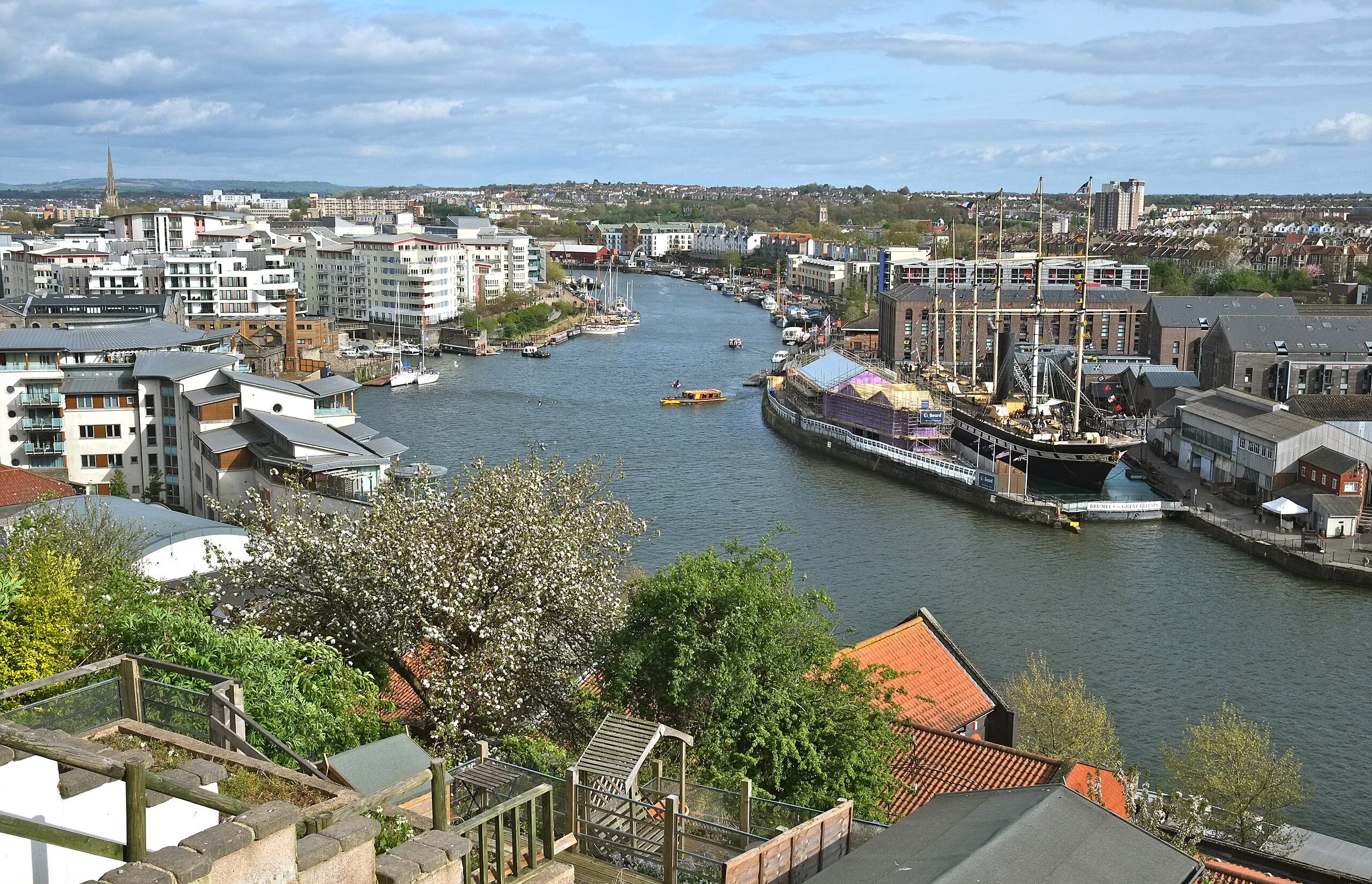
Anthony O’Neil, “Harbour View, Bristol,” Geograph, 15 April 2017, CC BY-SA 2.0.
This week, over cappuccinos in the RWA café, I had the pleasure of talking about the history of Bristol with Prof. Peter Malpass, co-author, with the late Andy King, of Bristol’s Floating Harbour: The First 200 Years1. Infrastructure is rarely celebrated and frequently contested, a dynamic that this book captures brilliantly. The harbour was the largest works undertaken in the city since the late 1240s, and its story is full of themes with contemporary resonance. Geo-politics, competition and innovation, deferred decision-making, public-private partnerships, conflict and lobbying, physical constraints, exploding project costs, even a drunken riot. And yet, from this chaos, an infrastructure emerged that still functions 215 years later, albeit for purposes that are far from the original commercial intent.
Indecision
In the late 18th century Bristol was losing more and more maritime trade to other ports, like Liverpool and London. A big part of the problem was geography and gravity. The harbour is more than 8 miles, along the River Avon, from the Bristol Channel, and navigation is dependent on one of the highest tidal ranges in the world. Ships could only move at daylight high tide (meaning several days monthly with no port activity), and when the tide was out, vessels could be grounded in mud and inaccessible for loading and unloading.
A joint Merchant Venturers2 and City Corporation committee had been formed in January 1792 to try to improve the harbour. This was immediately after the outbreak of war with Revolutionary France and yet, despite competitive and wartime urgency, they did little more than consider many proposals over the next decade. Finances were a major challenge: wharfage rents had funded maintenance and incremental improvements but seemingly hadn’t accumulated capital at the scale the upgrade required, so finally, in 1802, the Bristol Dock Company was formed.
“There’s a nice quote from 1792 in which the Merchant Venturers and the Corporation said .. if the harbour is going to be improved, it should not be for private gain, but for the benefit of the people or the public … And the dock company was completely different in conception from, say, the GWR, which was obviously about private individuals investing for profit, was about capital accumulation.”
They constructed an elaborate financial mechanism - rates, shares, Corporation guarantees - while never actually ensuring the financial structure could deliver what the engineering required. They then spent a decade seeking an engineering solution based on a funding model that would prove inadequate.
Building the Harbour
The new company decided to engage one of the most celebrated harbour engineers of the day, William Jessop. He had been senior consulting engineer for the docks at Dublin in the 1790s and had just completed working on the West India Dock in London in 1800. By 1802, Jessop himself had submitted three different Bristol schemes, revising each based on committee suggestions. Then the committee asked him to make significant changes that meant the design closely resembled an idea from one Reverend William Milton, who had submitted his plan back in 1791. Milton’s idea was a tidal bypass that preserved some current flowing past the harbour, helping to carry ships to and from the entrance. Exhausted with Bristol’s indecision, Jessop was “probably ready to agree to more or less anything that would mean the project would be approved.”3 and he quickly provided the engineering details for Milton’s layout.
“That crucial decision … to adopt Jessop’s plan, which increased the cost massively. That decision was made casually, just off the cuff really”
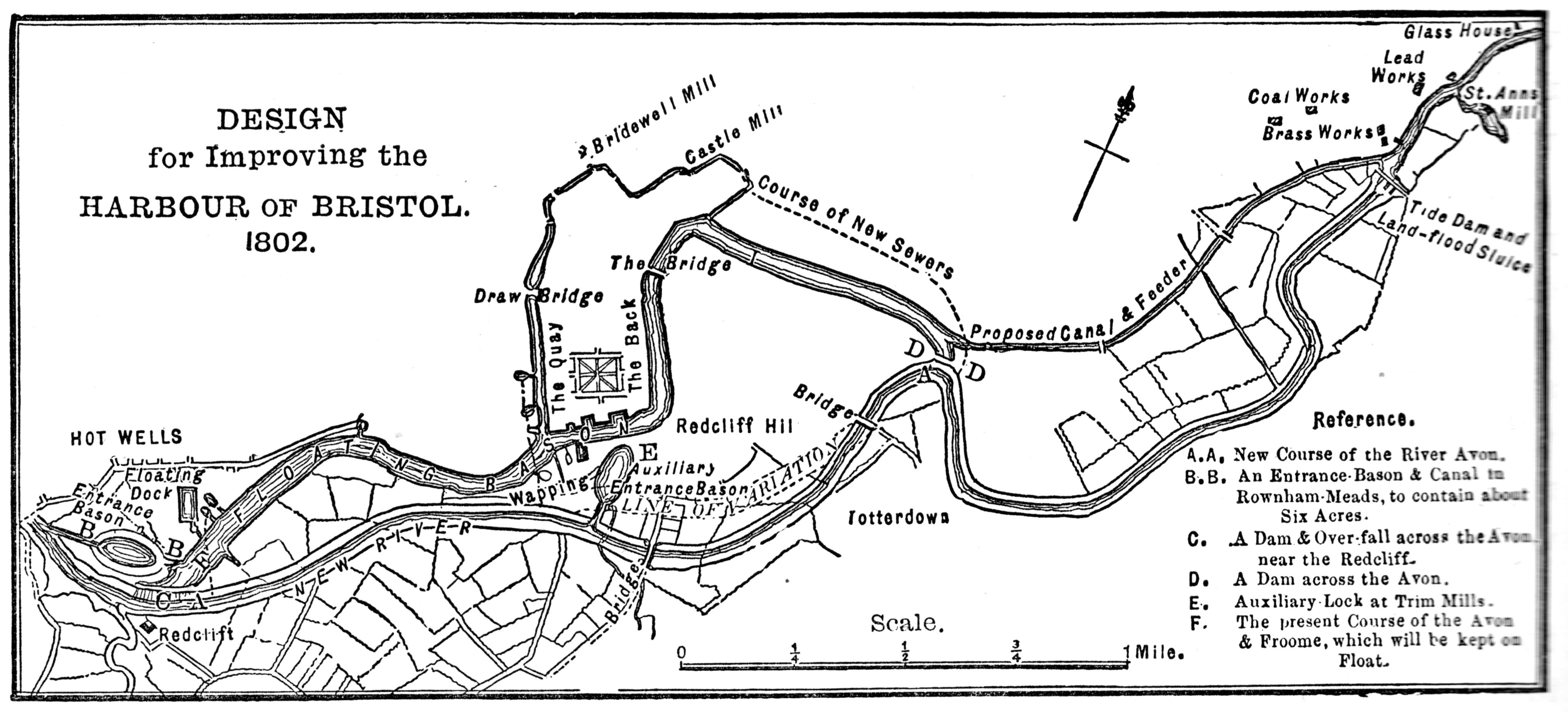
Jessop’s Plan (from J.F. Nicholls and John Taylor, Bristol Past and Present (Bristol: Arrowsmith, 1882), Internet Archive)
This decision proved to be politically divisive. Richard Bright4, a corporation member who had supported harbour improvement for years, became a determined opponent of the Milton-Jessop design5 as over-engineered and expensive - he and other merchants just wanted specific quays made accessible, not a grand solution for the entire waterfront.
“The point about the harbour, which lots of people today wouldn’t recognize, is that they were simply trying to keep ships afloat at the quays as they existed. We think of quays that were subsequently built, the whole harbour as providing a resource for tying ships, but actually that wasn’t part of the objective at all.”
Another key objection was to the financial model. The scheme levied rates not just on harbour users but on all surrounding property owners, regardless of whether they benefited. At every other British port, dock use was optional and proprietors competed for business; Bristol’s scheme forced all vessels to pay for infrastructure many didn’t require.
Bright led substantial powerful opposition but they lacked political leadership and the Corporation’s approval passed - by a single vote. Ultimately, construction took five years and employed around 1,000 men. The most dramatic element was the two mile New Cut, rerouting the Avon, carved through Triassic Redcliffe Sandstone. Total costs were nearly triple the original estimate. At least one person was happy.
“[the Reverend Milton] said in one letter, don’t worry about the cost. People won’t think about that in the future, that a wonderful thing that you’ve built.”
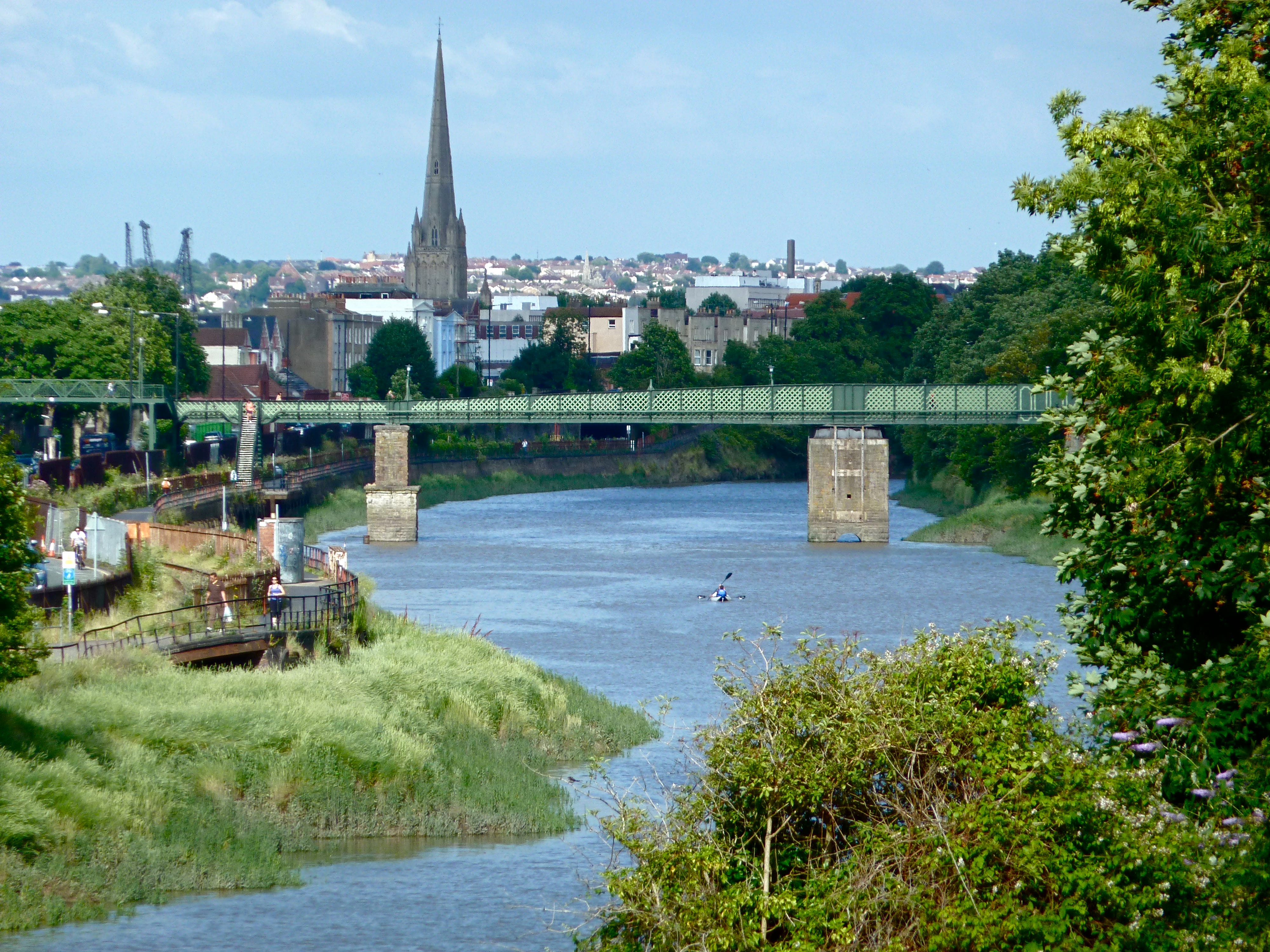
Anthony O’Neil, “Avon New Cut at Vauxhall Bridge from Ashton Bridge,” Geograph, 9 July 2010, CC BY-SA 2.0.
There was a completion celebration in May 1809. 1,000 labourers, two roasted oxen, and a gallon of beer per person erupted into violence between English and Irish workers that required the press gang to suppress6.
Fixing the Harbour
Stopping the tidal flow created a subsequent problem with sediment. This had been anticipated, Jessop included sluices alongside his Overfall (where excess water flowed over the top into the New Cut) that could be opened to create a current that was supposed to carry silt from the harbour. But the design was inadequate, and the port authority was forced to drain the harbour for hugely disruptive manual excavation. Eventually, in 1832, the Dock Company commissioned Isambard Kingdom Brunel to report on the state of the harbour. He had just won the competition for the proposed Clifton bridge7 and would remain consultant engineer to the Dock Company until 1849. He increased the emphasis on the Underfall, raising dam height and adding a bigger sluice at the bottom that could be opened at low tide, creating a more powerful undertow. He also designed a winch-operated drag-boat that churned up the floor so the sluices would suck out more silt.
The full solution finally came in the 1880s when John Ward Girdlestone, the city’s Docks Engineer, used the tidal range, the original problem, as the solution. He further extended Brunel’s principle and constructed the Underfall System, tunnels linking the harbour to the New Cut with a deep scouring sluice. When New Cut tide was low, opening the sluice created a pressure differential of several metres head, forcing water through the tunnel. The Underfall Yard became the operational hub8. In 1887, Girdlestone completed a Power House: pumps drew harbour water, pressurized it, stored it in a weight-loaded accumulator. This hydraulic network drove cranes, swing bridges, and lock gates throughout the docks.
Another problem was the poo.
“The dock company was supposed to make provision for removing sewage...The place got very unpleasant, very, very quickly.”
The Paving Commissioners, the authority responsible for streets and sanitation, brought legal action against the Dock Company over the sewage pollution. Forced to act, they built another Culvert (Mylne’s) in 1825-26, diverting the polluted Froom [Frome] underground to discharge into the New Cut.
“It took the s**t from the Froom and deposited it opposite Bedminster...It stayed there until the 1960s. Bristol didn’t have a sewage [treatment plant] until the 1960s.”
Basically, they moved the problem, not solved it. Thousands died in cholera and typhoid epidemics through the 1840s-60s before the city finally built 43 miles of sewers by 1874 - though these still just carried raw sewage to the tidal Avon9. For an almost unbelievable 135 years, raw sewage flowed untreated until Bristol finally built its first sewage treatment works at Avonmouth between 1960-1964.
The Next Phase
Despite the harbour, shipping continued to decline and then in 1908, Royal Edward Dock opened at Avonmouth and finally containerization made the infrastructure obsolete. Royal Portbury Dock was completed in 1972. The Floating Harbour closed to commercial traffic in 1975. The economic justification disappeared but the infrastructure didn’t. The harbour today is wonderful because Girdlestone solved a hydraulic problem that allowed it far outlast its original (always quite marginal) economic purpose. By the 1980s, residential moorings were established. The infrastructure now serves leisure craft, floating homes, heritage tourism.
“It was built for a single purpose, to bring ships in with materials and people. And if you close that function completely, then it’s hard to see any continuing...you can introduce new economic values by setting up yacht clubs or training schemes.”
Even that story was one marked by confusion and inertia. As Peter said.
“When I started thinking about the harbour, we were in Venice... Imagine in 1800 when Venice was in decline? People could have said, fill in a lot of these canals, build some cotton mills.”
Bristol nearly did just that. In the 1960s, a plan proposed filling in parts of the harbour to improve traffic flow.
“Fortunately, Bristol, because of its chronic inability to do things quickly, rejected [the] plan.”
The Lesson?
Geography and gravity create continuous obligations while economics creates episodic incentives. Bristol Dock Company wasn’t formed to build leisure infrastructure for the great-great-great-great-great-grandchildren of its investors. It was seeking to address contemporary needs, constructing improved commercial shipping infrastructure against a backdrop of relative economic decline. For that narrow goal, Richard Bright was arguably correct that the eventual scheme was too expensive/coercive. But from our 21st century perspective, what his political and economic viewpoint couldn’t see, was that Milton-Jessop, Brunel, Girdlestone et al. (eventually) produced an extraordinarily effective engineering solution that would outlast every political and economic objection.
Infrastructure always emerges from messy processes of convergence: geo-politics and competition meeting geographical constraint and local politics, private gains confused with public benefits, today’s requirements overwhelming the longer term even though what gets built creates obligations that outlast every original intention. A mix of Edmund Burke’s inherited judgment and Max Weber’s administrative scaffolding? As we finished our coffees, I asked Peter what he thought the lessons from the Harbour might be for contemporary infrastructure projects.
“It’s perhaps not very helpful, but it’s what I’ve already said, you never know what to do, because you don’t know what the future is going to hold. Given that you don’t know what the future is going to lead to, the challenge is how to make the right or the least wrong. Yeah, that’s right, the least wrong decision?”
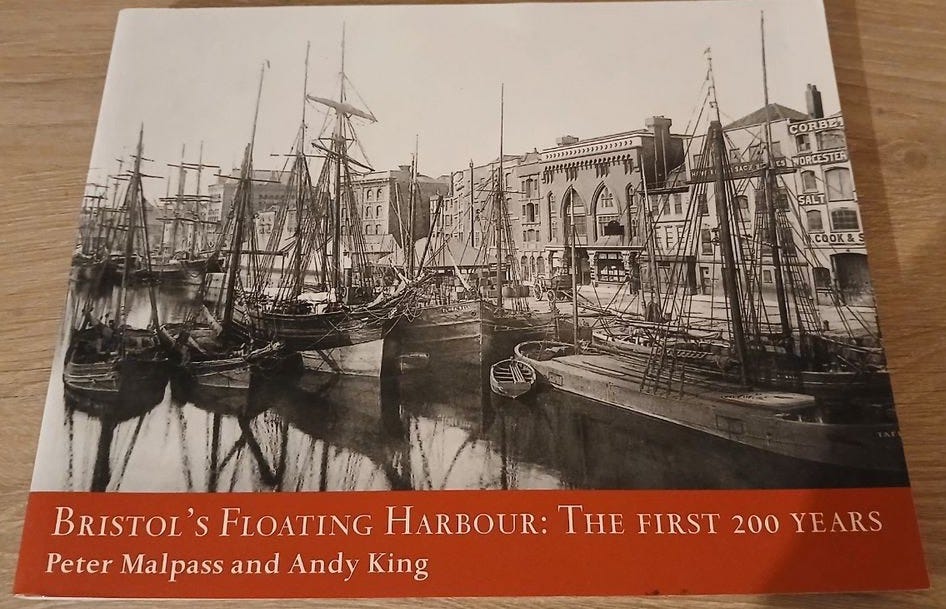
Malpass, P. and King, A. (2009) Bristol’s Floating Harbour: The First 200 Years. Bristol: Redcliffe Press Ltd. Many thanks to Steve Bullock, a harbour resident, for sharing his collection on the subject which included Peter’s book.
The Society of Merchant Venturers was chartered by Edward VI in 1552 with a monopoly on Bristol’s maritime trade and managed the harbour on behalf of the Corporation (Bristol’s city council) from the early 17th century, building quays, maintaining towpaths, and extracting wharfage rents until the Floating Harbour opened in 1809.
Malpass, P. and King, A. (2009) p.29
Malpass, P. (2023) ‘Richard Bright and the Politics of Harbour Improvement at Bristol’, Transactions of the Bristol & Gloucestershire Archaeological Society, 141, pp. 257-270.
Milton wasn’t formally acknowledged as the originator of the solution so he campaigned for recognition. In 1803 the Dock Company awarded him “a piece of plate, not exceeding the value of one hundred guineas”.
Latimer, John. The Annals of Bristol in the Nineteenth Century. Bristol: W. & F. Morgan, 1887, pp. 14-17.
In 1829, Thomas Telford judged the first competition, rejected all 22 designs including Brunel’s four submissions, and proposed his own expensive Gothic design instead. A second competition in 1831 initially declared Smith and Hawkes the winners, but 24-year-old Brunel personally persuaded judge Davies Gilbert to reverse the decision, securing his first major engineering commission.
In May 2023, an arsonist destroyed The Big Shed at the Underfall Yard, a Victorian workshop in continuous use for 135 years. The Underfall Yard Trust is rebuilding it to original specifications as a working boatyard with construction started in December 2024. https://underfallyard.co.uk/about/recovery/
This is a great blog, written by Lee Hutchinson, History curator at the M Shed museum, a long time collaborator and friend, who introduced me to Peter. https://collections.bristolmuseums.org.uk/stories/the-story-of-a-stinky-city-how-improved-sanitation-transformed-bristol/
Michael I always love reading your stories,
The title “Infrastructure That Outlasts Intent” recalls a Britain that once built. In the eighteenth century, intent was negotiated but structures endured. In the twenty-first, the logic has reversed: intent now outlasts infrastructure.
The Garden Bridge is the purest case. Around £53 million was spent on planning, design, and legal process. Nothing was built. The bridge exists only as reports, renderings, and invoices.
Britain no longer builds to outlast intent. It builds intent that outlasts building. And let’s not even talk of HS2!
Another thought on this great post Mike, an interesting thought experiment might be to ask what of our currently very energy-intensive infrastructure might be usefully repurposed in a low-carbon future? I've always felt that airports will make very good solar farm sites in the future with their large clear spaces and good electrical connections. If they are on a hill as at Bristol we could put a few windmills there too! Gemini tells me that Bristol is 323 hectares, which would have a capacity of 130-160MW peak - twice that of the current largest solar farm - and 125 to 160 GWh/year production.